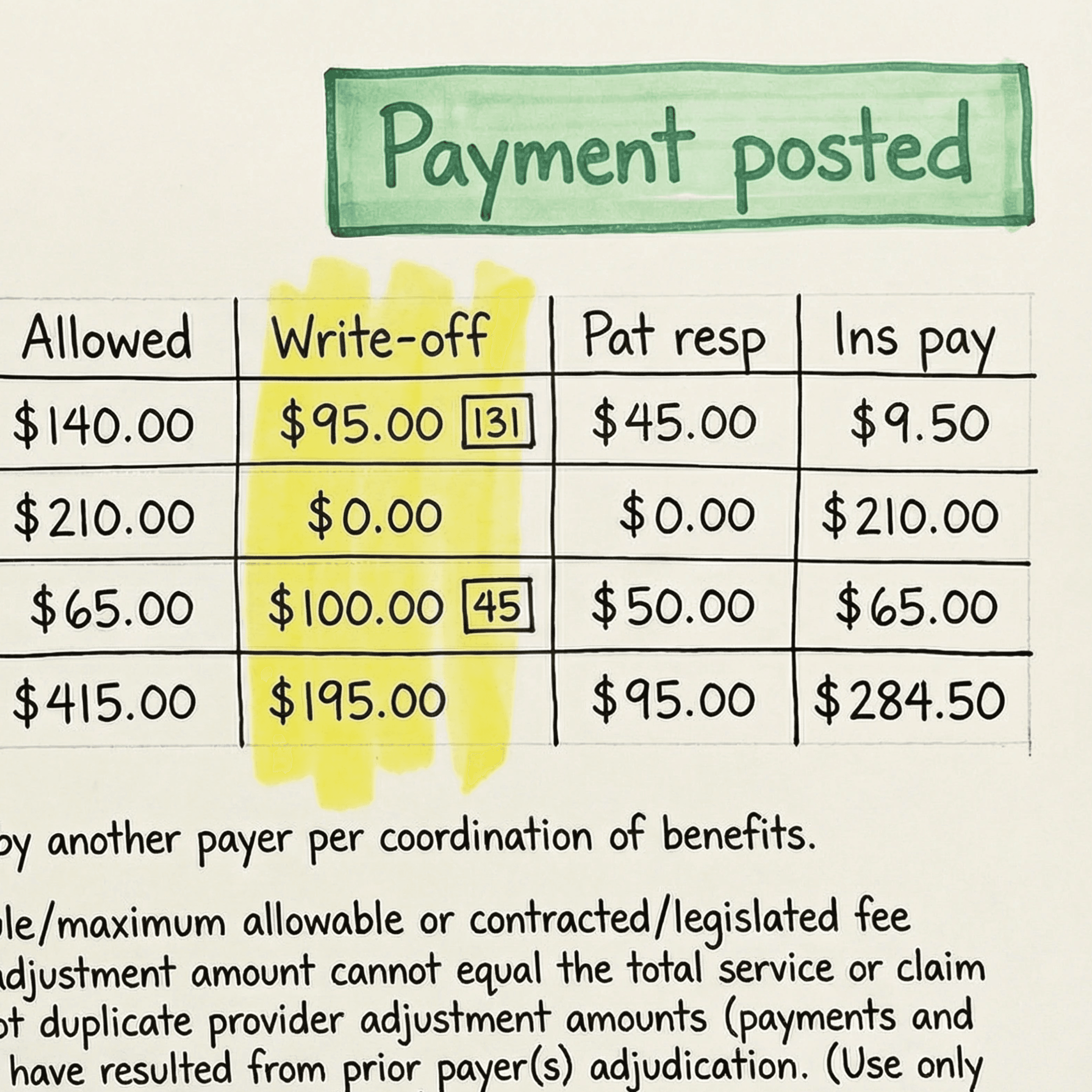

Why Write-Off Tracking Matters
A write-off in dental billing is the difference between your billed amount and the allowed amount under your contract with an insurance company. If you bill $200 for a procedure and your contracted rate is $140, the $60 difference is a contractual write-off.
That's straightforward when the write-off matches your contract. The problem is that it doesn't always match — and without systematic tracking, you'll never know.
Spotting Underpayments by Payer
Insurance underpayments are more common than most practices realize. A payer might reimburse $130 instead of the contracted $140. On a single claim, $10 might not raise flags. But across hundreds of claims per year from that payer, those $10 shortfalls add up to thousands of dollars.
When you track write-offs by payer, these patterns become visible. You can see that Delta Dental consistently pays $8 to $15 less than contracted on specific procedure codes. Or that MetLife applies frequency limitations that don't match your contract terms. Or that a specific payer downcodes certain procedures systematically.
Without payer-level tracking, these underpayments get absorbed into your general write-off bucket and disappear. With tracking, they become actionable data.
Understanding Your True Collection Rate by Payer
Your overall collection rate is a useful KPI, but it hides important variation. You might be collecting 98% on some payers and 85% on others. The low-performing payers drag down your average, but you can't fix what you can't see.
Payer-level write-off tracking lets you calculate a collection rate for each insurance company you work with. This is the data that powers real decision-making.
Want this handled for you? Teero’s Insurance Posting & Aging service posts every EOB, ERA, check and virtual card payment into your PMS each business day, then works the claims over 30 days old and the denials. You pay 2% of insurance collections, with volume discounts and an $800 monthly minimum.
Managing In-Network and Out-of-Network Payers
The in-network vs. out-of-network decision is one of the biggest financial choices a dental practice makes. Write-off data should be central to that decision.
In-Network Payers
For payers where you're in-network, your contractual write-offs are defined by your participation agreement. Tracking ensures those write-offs are applied correctly — that the payer is honoring the fee schedule you agreed to, and that your team is posting adjustments using the correct adjustment codes.
In-network write-off tracking also reveals the true cost of participation. If your contractual write-off with a payer averages 35% of billed charges, you need to know that. It affects your production targets, your scheduling decisions, and your profitability analysis.
Out-of-Network Payers
For payers where you're out-of-network, write-offs work differently. You bill your full fee, the payer reimburses based on their UCR (Usual, Customary, and Reasonable) schedule, and the patient is responsible for the difference. Your practice may or may not write off some portion of the patient's balance depending on your policy.
Tracking out-of-network write-offs helps you understand how much each payer's UCR schedule pays relative to your fees. If a payer's UCR rates are close to your full fee, staying out-of-network might make sense. If their rates are very low, the resulting patient balance may be difficult to collect, and going in-network — even with contractual write-offs — might yield better net revenue.
Use Data to Make Smarter Decisions
Once you have write-off data by payer, you can make decisions that directly impact your bottom line.
Negotiate Better Rates
When your contract comes up for renewal, payer-level write-off data is your best negotiating tool. Instead of accepting the payer's proposed fee schedule blindly, you can show exactly how much you're writing off, which procedure codes have the largest gaps, and what a fair adjustment would be.
Payers expect most practices to accept renewals without pushback. Practices with data-driven negotiation strategies stand out — and often get better rates. Even a 3-5% improvement on a high-volume payer can mean tens of thousands of dollars annually.
Decide Who to Be In-Network With
Not all insurance networks are created equal. Some payers compensate fairly. Others squeeze margins to the point where seeing their patients barely covers your overhead.
Write-off data tells you which networks are worth staying in and which ones deserve reconsideration. If Payer A's write-offs average 25% and Payer B's average 42%, that's a significant difference in profitability per patient — even if both payers send you similar patient volume.
This doesn't mean you should drop every low-paying payer. But it means you should make that decision with full financial visibility rather than habit or assumption.
Identify Fee Schedule Errors
Insurance companies update their fee schedules periodically, and errors happen. A payer might fail to update your contracted rates after a renegotiation. Or a system change on their end might cause certain procedure codes to be reimbursed at the wrong level.
Tracking write-offs at the procedure code level by payer catches these errors. If your write-off percentage on D2740 (porcelain crown) suddenly jumps from 28% to 40% with a specific payer, that's a signal worth investigating.
Setting Up Write-Off Tracking
Effective write-off tracking doesn't require expensive software — it requires consistent processes and good use of your existing tools.
Use Your PMS Correctly
Most Practice Management Systems can generate write-off reports by payer if the data is entered correctly. The key is making sure your team posts payments with the right adjustment codes and associates each write-off with the correct type: contractual adjustment, patient courtesy, bad debt, etc.
Keeping everything in your PMS is critical here. If some write-offs are tracked in spreadsheets, some are in your PMS, and some aren't tracked at all, your reports will be incomplete and misleading.
Standardize Adjustment Codes
Create a clear adjustment code mapping that your entire team follows. At minimum, distinguish between contractual adjustments (what you agreed to write off), discretionary adjustments (what you chose to write off), and uncollectible amounts (bad debt).
Without this distinction, your write-off reports lump everything together and become useless for payer analysis.
Post Payments Accurately and Daily
Write-off tracking is only as good as your payment posting. If payments are posted inconsistently, adjustments are applied incorrectly, or posting falls behind, your write-off data will be unreliable.
This is why daily payment posting is so important — it's the foundation that makes write-off tracking meaningful. Pair daily posting with solid best practices and your write-off data becomes a genuine strategic asset.
Run Reports Monthly
At minimum, pull a write-off report by payer monthly. Review the totals, look for trends, and flag any anomalies. Compare month-over-month to spot changes that might indicate a payer has adjusted their fee schedule or your team has changed how they're posting adjustments.
For deeper analysis, break write-offs down by procedure code within each payer. This level of detail reveals which specific services are being under-reimbursed and gives you targeted ammunition for fee negotiations.
Finding Platforms That Handle Custom Rules
Here's where it gets complicated: every practice has unique write-off rules. You might apply different write-off policies for different payers, different procedure types, or different patient situations. Managing these custom rules manually — especially across thousands of claims per month — is error-prone and time-consuming.
This is where the right technology or service partner makes a significant difference. Look for solutions that can:
Apply payer-specific fee schedules automatically during payment posting, so contractual write-offs are calculated correctly without manual lookup.
Flag payments that don't match expected amounts, so your team only reviews exceptions rather than every single payment.
Generate payer-level and procedure-level write-off reports without requiring manual data assembly.
Adapt to your specific office rules rather than forcing you into a one-size-fits-all approach.
At Teero, custom write-off rules are a core part of what we do. Every practice is different — different payer mix, different contracts, different philosophies about patient courtesy adjustments — and your payment posting process should reflect those differences. We configure our posting to match your rules exactly, within your PMS, so your reports are accurate and your financial data tells the true story.
If you're evaluating solutions, make sure to ask how they handle custom write-off logic. A platform that can only apply flat-rate adjustments won't serve a practice with complex payer relationships. You need something — or someone — that understands the nuance.
The Cost of Not Tracking
When write-offs go untracked, the consequences are invisible — which makes them dangerous. You don't see the money you're losing because it never shows up as missing. It just gets absorbed into the gap between production and collections, where it sits quietly alongside legitimate adjustments.
Over time, the cumulative impact is substantial. A practice with $1 million in annual insurance revenue and an average contractual write-off of 30% is writing off $300,000 per year. If even 5% of those write-offs are incorrect — underpayments, fee schedule errors, or improperly applied adjustments — that's $15,000 per year in recoverable revenue.
For many practices, the number is higher. And it compounds year after year until someone starts tracking.
The Bottom Line
Write-off tracking by insurance company is how you move from reactive billing to proactive financial management. It turns your payment data into a strategic tool — one that helps you spot underpayments, negotiate better contracts, make informed network decisions, and ensure your team is applying adjustments correctly.
The foundation is clean, consistent payment posting. The output is financial visibility that drives real decisions. And the right partner can help you get there faster, with custom rules that match the way your practice actually works.
Start tracking. The numbers will tell you exactly where to focus.