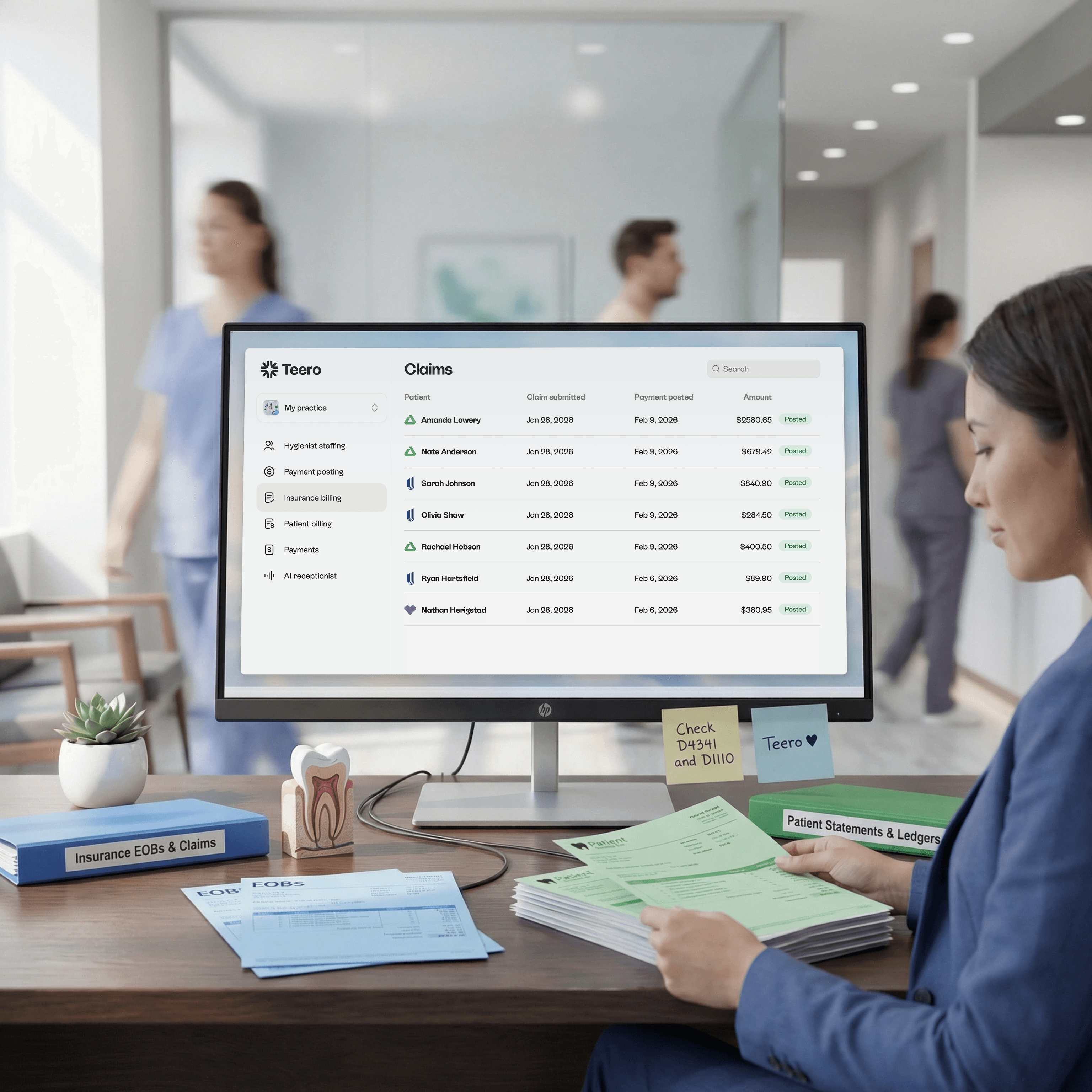
The future of dental payment posting: AI trends for 2026-2030
Payment posting sits at the center of dental revenue. When it lags, everything else backs up. Claims pile up, patient balances stay unclear, and front desk teams field more calls than they can handle. Most practices still rely on manual data entry from EOBs and payer portals. That means delays, missed adjustments, and errors that take weeks to unwind.
Over the next few years, AI will change how payments move from payers to practice software. The shift is not theoretical. Early tools already post payments from ERA files, flag mismatches, and reconcile deposits. What changes between 2026 and 2030 is depth, accuracy, and coverage across payers and edge cases.
Below is what is coming, what problems it solves, and how to prepare without disrupting your current workflow.
Why payment posting is still a bottleneck
Before looking ahead, it helps to be clear about the current pain points:
ERA and EOB inconsistency. Payers format data differently. Line items do not always match procedures. Adjustments are coded in ways that require human judgment.
Manual data entry. Staff key in payments, write-offs, and remarks. Even with dual monitors, it is slow and error-prone.
Reconciliation gaps. Deposits in the bank do not always match what was posted. Teams spend hours tracking down small variances.
Secondary claims delays. If primary posting is late or wrong, secondary claims go out late or get denied.
Patient confusion. If posting is delayed, statements go out with the wrong balance. That leads to calls, refunds, and loss of trust.
Staffing strain. Posting work competes with phones, check-ins, and treatment coordination. Burnout is common.
AI will not remove the need for human oversight. It will reduce the volume of routine work and surface the cases that need attention.
Trend 1: ERA and EOB normalization at scale
The first wave is better normalization of payer data. AI models trained on large sets of ERAs and scanned EOBs can map inconsistent fields into a standard structure. They learn payer quirks and apply them automatically.
What changes:
Higher auto-post rates. More lines post without manual touch, even when the payer uses unusual remark codes.
Fewer mapping rules to maintain. Today many systems rely on brittle rules that break when a payer updates a format.
Better handling of paper EOBs. Optical character recognition plus model-based parsing can extract line items and adjustments with higher accuracy than legacy OCR.
What to do now:
Track your current auto-post rate by payer. Identify the worst offenders.
Standardize your procedure codes and fee schedules. Clean inputs improve model performance.
Keep a library of common payer exceptions. This will help validate any new system you test.
Trend 2: Context-aware posting and smart adjustments
Posting is not just copying numbers. It requires context. Is this a contractual adjustment or a downgrade. Does the allowed amount match the fee schedule. Should a balance move to patient or secondary.
New systems combine claim data, fee schedules, and plan details to make these calls.
What changes:
Accurate write-offs. Models apply the correct adjustment type based on plan rules and historical outcomes.
Fewer silent errors. If an allowed amount is off by a small margin, the system flags it instead of posting it blindly.
Cleaner ledgers. Patient and insurance portions are split correctly, which reduces statement corrections.
What to do now:
Audit a sample of posted claims each week. Look for patterns in misapplied adjustments.
Keep fee schedules current. Outdated schedules create false mismatches.
Document your posting policies. Clear rules help you evaluate AI output.
Trend 3: Real-time reconciliation with bank deposits
Reconciliation often happens days after posting. By then, tracing a discrepancy is harder.
AI tools are moving toward real-time reconciliation between ERA batches, virtual card payments, and bank deposits.
What changes:
Daily close becomes feasible. You can match what was posted to what hit the bank on the same day.
Faster variance detection. Small differences are caught early, when the trail is still fresh.
Less end-of-month scramble. Finance and operations get a clear view of cash flow throughout the month.
What to do now:
Separate payment methods in your accounting. Track EFT, virtual cards, and checks distinctly.
Store remittance advice with each deposit. Even a simple naming convention helps.
Set a target for daily or twice-weekly reconciliation, even if manual today.
Trend 4: Automated secondary and tertiary claim triggers
Secondary claims often depend on accurate primary posting. Delays or errors ripple forward.
AI systems can trigger secondary claims as soon as primary payment posts, with the correct attachments and coordination of benefits data.
What changes:
Shorter time to secondary submission. This improves overall days in A/R.
Fewer coordination errors. The system carries forward the right fields from the primary EOB.
Better tracking. You can see where each claim sits across payers.
What to do now:
Map your current secondary workflow. Identify handoffs and delays.
Ensure coordination of benefits is updated in the patient record.
Monitor secondary denial reasons. Many tie back to primary posting issues.
Trend 5: Denial prediction tied to posting data
Posting data contains signals about payer behavior. If a payer consistently underpays certain codes or applies specific remarks, models can predict likely denials on similar claims.
What changes:
Early alerts. You can flag claims at risk before or right after submission.
Targeted follow-up. Staff focus on claims that need intervention, not the entire aging report.
Feedback loops. Posting outcomes inform front desk estimates and coding choices.
What to do now:
Tag common denial reasons in your system. Consistent labels matter.
Share posting insights with front desk and clinicians. Patterns should change behavior.
Set thresholds for follow-up. For example, claims with certain remarks get reviewed within 48 hours.
Trend 6: Patient balance accuracy and fewer surprise bills
Delayed or incorrect posting leads to statements that do not reflect reality. Patients get a bill, then a correction, then a refund.
AI improves timing and accuracy, which tightens the link between treatment, insurance payment, and patient responsibility.
What changes:
More accurate statements on first send.
Fewer refunds and re-bills.
Better patient conversations because balances are current.
What to do now:
Align statement cycles with posting cycles. Avoid sending statements before large batches post.
Use clear remark codes on patient statements where possible.
Train staff to explain common insurance adjustments in plain language.
Trend 7: Exception-first workflows
The goal is not full automation. The goal is to remove routine work and surface exceptions.
Modern systems route only the edge cases to humans, with context attached.
What changes:
Work queues shrink but get more meaningful.
Each exception includes suggested actions and supporting data.
Training new staff becomes easier because the system guides decisions.
What to do now:
Define what counts as an exception in your practice. For example, allowed amount variance over a set threshold.
Create simple playbooks for each exception type.
Measure time spent per exception. This will show the impact of any new tool.
Trend 8: Integration with eligibility and estimates
Payment posting does not live in isolation. It connects back to eligibility checks and treatment estimates.
AI systems will tie these together. If posting shows a payer applies a downgrade on a code, future estimates can reflect that pattern.
What changes:
Estimates get closer to actuals over time.
Fewer patient disputes about expected versus final cost.
Better scheduling decisions for high-value procedures.
What to do now:
Keep eligibility data structured, not just screenshots or notes.
Compare estimates to final EOBs on a sample basis each month.
Update estimate templates when patterns emerge.
Trend 9: Support for complex payer scenarios
Some cases will always be messy. Out-of-network payments, missing information, or mixed coverage plans.
AI is getting better at these, but not perfect.
What changes:
Higher assist level in complex cases. The system gathers documents, highlights inconsistencies, and suggests next steps.
Faster research. Instead of digging through portals, staff see relevant snippets tied to the claim.
What to do now:
Keep documentation centralized. Attach EOBs, notes, and correspondence to the claim.
Standardize naming for attachments so they are easy to find.
Build a small knowledge base of payer-specific quirks.
Practical steps to prepare in 2026
You do not need a full system overhaul to benefit from these trends. A few focused steps go a long way:
Clean your data. Accurate fee schedules, consistent coding, and complete patient insurance records improve any automation.
Measure your baseline. Track days in A/R, auto-post rate, denial rate, and time to reconcile deposits.
Pilot with one payer or one location. Compare before and after on a small scale.
Keep humans in the loop. Set review thresholds and audit samples regularly.
Protect staff time. Use automation to reduce repetitive entry, not to pile on more tasks.
What this means for staffing
Payment posting has been a training ground for new hires and a time sink for experienced staff. As routine work shrinks, roles will shift:
Front desk teams spend less time on posting and more on patient communication and scheduling.
Billing specialists focus on exceptions, denials, and payer follow-up.
Managers get clearer visibility into cash flow without waiting for end-of-month reports.
This can ease burnout, but only if practices adjust responsibilities and expectations. If you keep the same workload and add new tools, frustration will rise.
Risks to watch
AI will not fix broken processes on its own. A few pitfalls to avoid:
Blind trust. High auto-post rates can hide systematic errors if you do not audit.
Poor integration. If your practice management system and accounting do not sync cleanly, reconciliation will still hurt.
Data drift. Fee schedules and plan details change. If inputs are stale, outputs will be off.
Over-customization. Heavy rule sets can conflict with model decisions and create confusion.
Compliance gaps. Any system handling patient data should align with HIPAA for Professionals expectations for privacy and security.
Conclusion
Between 2026 and 2030, dental payment posting will move from manual entry to exception-driven workflows with real-time visibility. Practices that prepare their data, define clear rules, and keep oversight in place will see faster collections and fewer patient issues.
If you are exploring ways to reduce posting workload and tighten reconciliation, Teero’s revenue cycle tools focus on remote dental billing and automated payment posting, which can help practices move toward this model without overhauling their entire stack.