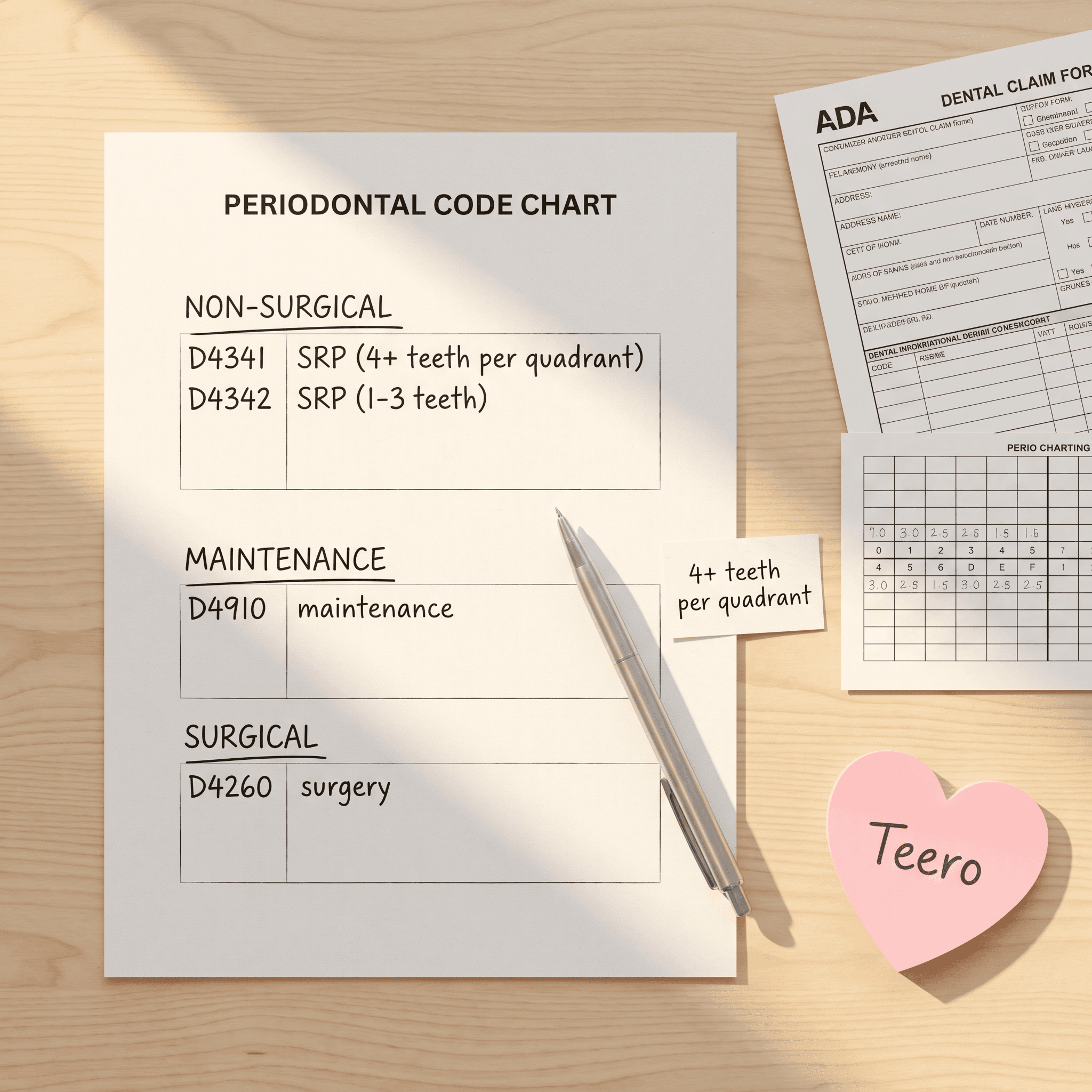
Periodontal billing: SRP, maintenance, and surgery codes
Periodontal procedures are some of the most misbilled services in dentistry. Offices deal with denied claims, downgraded reimbursements, and confused patients who thought insurance would cover more. Front desks spend hours on hold with payers trying to verify benefits that still don’t match the EOB. Hygienists feel the pressure when treatment plans get questioned at checkout.
Most of the friction comes down to a few CDT codes and how they are documented and sequenced. SRP, periodontal maintenance, and surgical procedures all have specific rules. Small mistakes can delay payment or trigger audits.
This guide focuses on the details that tend to trip up busy dental teams and what to do differently.
SRP coding (D4341 and D4342)
SRP coding is coded by quadrant:
D4341: four or more teeth per quadrant
D4342: one to three teeth per quadrant
On paper, that sounds simple. In practice, several issues come up.
Common SRP billing problems
Incorrect quadrant selection
If the charting does not clearly support the number of affected teeth, payers may downcode from D4341 to D4342 or deny the claim.
Missing clinical criteria
Many payers expect documentation of periodontal disease, not just gingivitis. That often means pocket depths of 4 mm or more, clinical attachment loss, bleeding on probing, and radiographic bone loss.
Frequency limitations
Plans often limit SRP to once every 24 months per quadrant. If a patient had SRP at another office, your claim may be denied unless you have records or a narrative explaining disease recurrence.
Confusion with D4355 (full mouth debridement)
Some offices use D4355 when they cannot complete a comprehensive exam due to heavy buildup. Payers may flag cases where D4355 is followed too quickly by SRP without updated charting.
How to reduce SRP denials
Attach full periodontal charting with dates. Include six-point probing, bleeding, recession, and furcation where present.
Include recent radiographs that show bone loss. Bitewings are often not enough for advanced cases.
Add a short narrative that ties findings to treatment. Example: "Generalized 5 to 7 mm pockets with bleeding on probing and radiographic bone loss. SRP indicated for active periodontitis."
Verify plan limitations before treatment. If SRP was done recently, prepare the patient for possible out-of-pocket costs.
Avoid mixing D4341 and D4342 within the same quadrant unless the chart clearly supports it.
Periodontal maintenance (D4910)
Periodontal maintenance (D4910) is one of the most misunderstood codes. It is not a "better prophy." It is a distinct service following active periodontal therapy.
When D4910 applies
The patient has completed SRP or periodontal surgery.
The patient is on a periodontal maintenance schedule, often every three to four months.
The visit includes evaluation of periodontal status, site-specific scaling, and management of inflammation.
Common D4910 pitfalls
Billing D4910 too early
Many payers require a waiting period after SRP before they will cover D4910. Some require a re-evaluation first, often coded as D0171.
Switching back to prophy (D1110)
Offices sometimes alternate D4910 with D1110 to match insurance frequency limits. That can trigger audits. If the patient has a history of periodontitis, most plans expect D4910 for ongoing care.
Frequency limits and downgrades
Some plans only cover two periodontal maintenance visits per year. Additional visits may be patient responsibility or downgraded to D1110.
Lack of documentation
If the clinical notes look like a routine prophy, payers may deny or downgrade. Notes should reflect periodontal maintenance, not just "prophy completed."
How to bill D4910 correctly
Document periodontal history clearly in the chart. Include dates of SRP or surgery.
Record updated periodontal findings at each visit. Note pocket depths, bleeding, mobility, and areas treated.
Use D0171 when a re-evaluation is clinically indicated after SRP, especially if the plan requires it before maintenance.
Set expectations with patients. Explain that maintenance is different from a standard cleaning and may have different coverage.
Check frequency limits before scheduling. If a patient wants three or four visits per year, explain coverage gaps upfront.
Periodontal surgery codes
Surgical periodontal procedures vary by site and technique. The most common codes include:
D4240 and D4241: gingival flap procedures (including root planing)
D4260 and D4261: osseous surgery
D4270 and D4271: pedicle soft tissue grafts
D4273 and D4274: connective tissue grafts
D4263 and D4264: bone replacement grafts
D4265: biologic materials to aid in soft and osseous regeneration
Each code has specific documentation expectations. Missing details can lead to partial payment or denial.
Common surgery billing issues
Insufficient narratives
Payers often require a clear description of the procedure, sites treated, and why surgery was needed after non-surgical therapy.
Missing pre-op data
Without pre-operative charting and radiographs, it is hard for payers to justify surgery. Claims get pended or denied.
Incorrect tooth or site mapping
Errors in tooth numbers or surfaces can delay processing or result in payment for the wrong site.
Bundling and downgrades
Some plans bundle grafting materials into the primary procedure or downgrade certain techniques to less expensive alternatives.
Documentation that supports surgical claims
Pre- and post-operative periodontal charting
Diagnostic radiographs that show bone defects
A narrative that explains failure or limits of SRP and why surgery is indicated
Details on materials used, especially for grafts and biologics
Clear site mapping by tooth and surface
Tips to improve surgical reimbursement
Submit complete documentation with the initial claim. Waiting for a request adds weeks to the cycle.
Use intraoral photos when helpful. They can support soft tissue conditions and recession.
Check plan exclusions for graft materials before treatment. Some plans will not cover certain biologics.
Coordinate benefits if the patient has dual coverage. Surgical cases are expensive, and coordination errors are common.
Coordination between clinical and front desk teams
Many periodontal billing problems start with a disconnect between what is done clinically and what is submitted.
Hygienists and doctors document findings in one style. Front desk teams translate that into codes and narratives under time pressure. If the chart is incomplete or inconsistent, the claim suffers.
A few practical changes help:
Standardize periodontal charting. Use the same format across providers.
Create quick templates for SRP, maintenance, and surgical narratives. Keep them short but specific.
Hold short weekly reviews of denied claims. Look for patterns by payer and procedure.
Give front desk teams a checklist for attachments. Charting, radiographs, narratives, and photos when needed.
Insurance verification and patient communication
Insurance verification and patient communication is critical because periodontal treatment plans often span multiple visits and months of care. If benefits are not verified accurately, patients get surprise bills.
Common gaps include:
SRP frequency limitations per quadrant
Waiting periods for periodontal services
Maintenance frequency limits
Missing history from previous offices
To avoid this:
Verify benefits at the procedure level, not just "periodontal covered." Ask about frequencies, downgrades, and waiting periods.
Request history when possible. If the patient had SRP elsewhere, document dates and obtain records.
Provide written estimates that reflect likely coverage and patient responsibility.
Update estimates if the plan responds with a downgrade or limitation.
Managing denials and re-submissions
Even with good documentation, denials happen. The difference between slow and steady collections is how quickly and accurately you respond.
Read the EOB carefully. Identify if the issue is documentation, frequency, or plan exclusion.
For documentation issues, resubmit with missing attachments and a clearer narrative.
For frequency denials, check if a narrative about disease progression applies. Include supporting charting.
Track resubmissions and follow up within a set timeframe. Do not let claims sit past payer appeal windows.
The staffing angle
Periodontal billing often falls on the same people who answer phones, check patients in, and chase claims. When a hygienist calls out or the schedule is overbooked, documentation gets rushed and errors creep in.
Short-staffed days lead to:
Incomplete charting
Missing attachments
Delayed claim submission
More denials weeks later
Filling hygiene gaps and keeping documentation consistent has a direct effect on revenue. Staffing and capacity constraints are also a real, measurable pressure point for practices—see Bureau of Labor Statistics, Dental Hygienists for current workforce outlook and role expectations.
Where systems help
Most of these problems are not about effort. They are about time, consistency, and access to accurate information.
Eligibility checks done ahead of time reduce surprises at checkout.
Standard templates reduce variation in narratives.
Organized attachment workflows cut down on pended claims.
Dedicated billing support speeds up resubmissions and follow-ups.
Eligibility and benefits workflows are also shaped by standard transactions like the X12 (270/271 eligibility EDI standard). Teero’s revenue cycle management tools handle remote dental billing and automated payment posting, which helps teams keep periodontal claims clean and collections moving without adding more work to the front desk.